

A hedge doesn't need to go in the ground. Some of the best privacy screens we've seen are growing in timber planter boxes — on concrete, on rental properties, over the top of tired old fences, in corners where the ground is rubbish. Get the variety and the depth right and a planter box hedge will do everything an in-ground hedge does, with a few tricks an in-ground hedge can't manage.
This guide covers the two most-asked-about hedge plants — lilly pilly and bamboo — plus what else works, how deep the box needs to be, and how to keep the whole thing thriving.
Can you really grow a hedge in a planter box?
Yes — as long as you pick varieties bred for restricted root space and give them a decent depth of potting mix. Compact lilly pilly cultivars and clumping bamboo are the two standouts in Australia, and both are sold specifically for exactly this job. The plants that fail in planters are the ones people plant out of habit: full-size trees, running bamboo, and big old-fashioned hedge species that want metres of open ground.
The short version:
- Lilly pilly — choose a compact, psyllid-resistant variety (more below). Dense, glossy, native, clips into a neat formal hedge.
- Clumping bamboo — the fastest screen you can grow, and a planter box is actually the safest place to grow it.
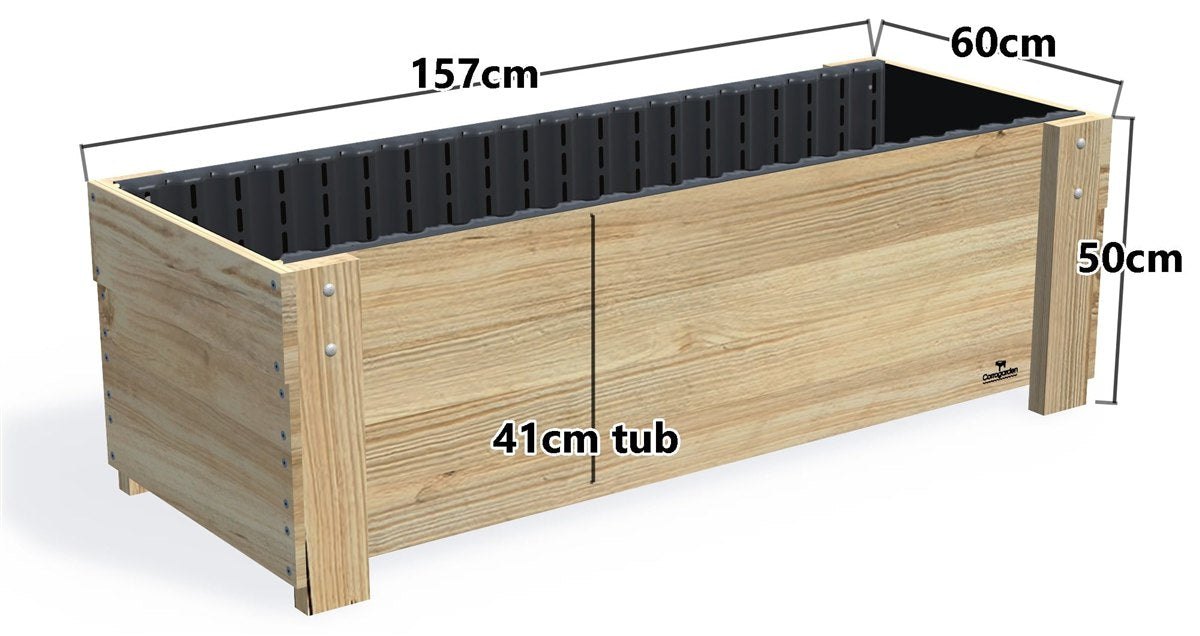
- Depth matters — go for the deepest tub you can. Our planter boxes come with a 41 cm deep tub option, which is right in the recommended range for screening plants.
Why grow a hedge in a planter box instead of the ground?
Because a planter box solves the problems that stop most hedges ever being planted. If you had deep, healthy, empty ground exactly where you need privacy, you'd probably already have a hedge there. Most of us don't. Here's what the box changes:
- Instant height head start. The planting surface in a knee-high planter box sits around 50 cm off the ground — waist height in our 80 cm beds. A 1.5 m plant is a 2 m screen from day one, which is how you get greenery above the fence line without waiting years.
- It works where there's no ground. Concrete courtyards, paved side strips, decks, balconies. The hedge goes where the sightline problem is, not where the dirt happens to be.
- Renting? Take it with you. A hedge in a planter box isn't a landscaping change — it's furniture. Add wheels and it moves for the removalist truck like everything else. Our planter box on wheels was built for exactly this.
- Premium potting mix from day one. No clay, no builder's rubble, no competing tree roots stealing the water. You fill the box with premium potting mix and the hedge gets all of it.
- Contained roots. The growing tub keeps roots away from pipes, footings, and the neighbour's side of the fence. For bamboo, this is the whole ball game — more below.
- A screen you can rearrange. On castors, your hedge follows the problem: block the western sun in summer, screen the outdoor dining area for a party, open the view back up in winter.
Which lilly pilly is best for a planter box?
Go for a compact, psyllid-resistant variety — 'Resilience' and 'Backyard Bliss' are the two most recommended for restricted root space, and 'Straight and Narrow' is the pick for tight, skinny spots. Lilly pilly psyllid is the sap-sucking insect that gives older varieties those ugly bumpy leaves; modern cultivars were bred to shrug it off, so there's no reason to plant a susceptible one. Yates' lilly pilly growing guide has a good rundown of the species.
For a lower hedge (under a metre or so of foliage), dwarf forms like 'Allyn Magic' and 'Minnie Magic' stay naturally small and barely need trimming.
Planting and spacing. Screening plants are usually spaced at 50–75% of their mature width for a dense wall of foliage. In a full-length planter box (ours are 157 cm long inside), that's two to three plants. Plant them slightly closer than you would in the ground — in a planter you want the gaps closed fast.
Growth rate. In good conditions most hedging lilly pillies put on around a metre a year, so a 2 m screen inside two years is a realistic expectation from semi-advanced plants.
The care it actually needs:
- Water deeply once or twice a week — more in summer, because planters dry out faster than the open ground. This is the one job that decides whether a planter hedge thrives. A drip watering kit with a timer takes it off your plate entirely.
- Feed with a slow-release fertiliser in spring and again in early autumn. Lilly pillies are hungry when they're growing fast.
- Trim little and often. Light tip-pruning after each growth flush keeps the hedge dense right down to the base. Lilly pillies respond brilliantly to clipping — that flush of bronze-red new growth after a trim is half the appeal.
- Bonus: the berries are edible. Tart, crisp, and an old bush-tucker staple for jams.
Is bamboo safe to grow in a planter box?
Clumping bamboo, yes — and a planter box is arguably the best place to grow it. The horror stories about bamboo taking over yards all involve running bamboo, which spreads by underground runners and doesn't respect fences. Clumping varieties like Bambusa textilis 'Gracilis' (Slender Weavers — the most popular screening bamboo in Australia) grow as a slowly widening tussock instead — Burke's Backyard explains the difference well. Put that clump in a planter box with a solid tub and its roots have a physical boundary they cannot cross. The thing that scares people about bamboo simply isn't in play.
Never plant a running bamboo, in a planter or anywhere else — if the label doesn't clearly say "clumping," walk away.
What to expect. In the ground Gracilis reaches 6–8 m; in a planter it typically tops out around 3–4 m — which for a privacy screen is plenty, and easier to manage. It's quick: healthy clumping bamboo can add a metre or more of height in a single growing season, making it the fastest route to a green wall that exists.
Planting. Two plants per full-length box, roughly 80 cm apart. Container guides recommend around 35–45 cm of potting mix depth per screening plant — choose the 41 cm deep tub on our timber planter box.
The care it actually needs:
- Bamboo is thirsty. It's the trade-off for the speed. Expect deep watering two to three times a week in summer. If you're not a reliable waterer, fit a drip system or choose lilly pilly instead — we'd rather tell you that now than after your bamboo browns off.
- Drainage matters as much as water. Bamboo drinks hard but hates wet feet, so free-draining potting mix and clear drainage holes are non-negotiable.
- Feed like a lawn. Bamboo is a grass, so it loves nitrogen — a lawn fertiliser in spring and summer keeps it deep green.
- Thin it occasionally. Cut the oldest, dullest canes at the base every year or two. The clump stays open, fresh canes come up better, and the screen looks intentional instead of wild.
- Every few years, lift and divide the clump (or root-prune) to keep it vigorous. This is standard for any long-term container bamboo.
What are the best screening plants for a planter box?
Lilly pilly and bamboo are the headliners, but they're not the only choice — here's how the twelve screening plants we're asked about most compare in a planter. Heights are what to expect in a 41 cm deep planter tub, not open ground.
| Plant | Height in a planter | Speed | Thirst | Frost | Best climates | Flowers | Hedge style |
|---|---|---|---|---|---|---|---|
| Lilly pilly 'Resilience' / 'Backyard Bliss' | 2–3 m | Fast | Moderate | Hardy | Everywhere bar alpine | Fluffy white, then edible berries | Formal or loose |
| Dwarf lilly pilly ('Allyn Magic', 'Minnie Magic') | 0.8–1 m | Moderate | Moderate | Hardy | Everywhere bar alpine | White fluff, red new growth | Neat low border |
| Slender Weavers bamboo (Gracilis) | 3–4 m | Very fast | High | Hardy | Everywhere bar alpine | None — it's a grass | Tall narrow curtain |
| Murraya (orange jessamine) | 2–2.5 m | Fast | Moderate | Light frost only | Subtropical, warm temperate | Perfumed white, several flushes a year | The formal classic |
| Magnolia 'Teddy Bear' / 'Little Gem' | 2.5–3 m | Slow–moderate | Moderate | Hardy | Most climates | Huge perfumed cream cups | Stately, informal |
| Sweet viburnum 'Dense Fence' | 2–3 m | Very fast | Moderate–high | Light–moderate frost | Temperate, subtropical | Small white clusters | The instant screen |
| Photinia 'Red Robin' | 2–3 m | Fast | Low–moderate | Very hardy | Cool, temperate | White spring heads | Formal, red-topped |
| Westringia (native rosemary) | 1.5–2 m | Moderate | Very low | Hardy + salt-proof | Everywhere incl. coast | White-mauve, most of the year | Native "box" look |
| Pittosporum 'Silver Sheen' | 2–3 m | Fast | Moderate | Hardy | Cool, temperate | Tiny, honey-scented | Shimmery, informal |
| Camellia sasanqua | 2–3 m | Slow–moderate | Moderate | Hardy | Most; loves part shade | Showy autumn–winter | Formal, glossy |
| Callistemon 'Slim' (bottlebrush) | 2–3 m | Fast | Low | Hardy | Everywhere | Red brushes, bird magnet | Narrow native |
| Star jasmine (climber, on a trellis) | 1.6–1.8 m | Fast | Low–moderate | Hardy | Everywhere | Perfumed white, spring–summer | Green wall on mesh |
The one-line pro and con for each
- Lilly pilly — For: the all-rounder: native, dense, clips beautifully, bird-friendly. Against: plant a psyllid-resistant variety or regret it.
- Dwarf lilly pilly — For: barely needs trimming. Against: tops out around waist height — it's a border, not privacy.
- Slender Weavers bamboo — For: the fastest, tallest, narrowest screen there is. Against: the thirstiest thing on this list; fit a drip line.
- Murraya — For: that jasmine perfume on a hedge the east coast has loved for decades. Against: sulks in real frost — cold-district gardeners look elsewhere.
- Magnolia 'Teddy Bear' — For: the premium look; dinner-plate flowers on glossy bronze-backed leaves. Against: slow, and advanced plants cost real money.
- Sweet viburnum — For: nothing legal fills a gap faster. Against: keeps growing after it fills it — commit to clipping.
- Photinia 'Red Robin' — For: the cold-climate stalwart with two flushes of red a year. Against: some people dislike the spring flower smell; clip it and they don't come.
- Westringia — For: survives coastal wind, drought and neglect that kill everything else here. Against: fine grey-green texture reads "native", not "English hedge".
- Pittosporum 'Silver Sheen' — For: light, shimmering, sophisticated — Melbourne's favourite. Against: dislikes humid summers and wet feet.
- Camellia sasanqua — For: the only screen that flowers all winter, and the best pick for shade. Against: patience required for the first couple of years.
- Callistemon 'Slim' — For: bred narrow for screening; lorikeets will thank you. Against: texture is loose — it screens without looking clipped.
- Star jasmine — For: turns a trellis into a perfumed green wall on a few dollars of plant. Against: it needs the trellis — it's a climber, not a shrub.
Should a privacy screen be deciduous?
No — for privacy, always evergreen. A deciduous screen (ornamental pear, crepe myrtle, maple) drops every leaf at once, and your neighbour's window reappears for three months every winter. If you love a deciduous tree, plant it as a feature and let an evergreen do the screening. Every plant in the table above holds its leaves year-round.
Which screening plant suits your climate?
- Cool (frosty winters): photinia, camellia sasanqua, pittosporum, lilly pilly 'Resilience'.
- Temperate: almost everything on the list — pick on looks and speed.
- Subtropical: murraya, lilly pilly, bamboo, sweet viburnum.
- Coastal / windy: westringia first, callistemon second.
- Shade: camellia sasanqua, star jasmine on a trellis.
- Can't water reliably: westringia, callistemon — and skip the bamboo.
Whatever you pick: compact cultivar, the 41 cm deep tub, premium potting mix, and water more often than you would in the ground.
How deep does a planter box need to be for a hedge?
Aim for around 40 cm of potting mix depth — container growing guides recommend roughly 35–45 cm per screening plant, and more mix means faster growth and less frequent watering. That's why we'd steer hedge-growers to the 41 cm deep tub across our planter box range: on the full-length box that's a 270 litre tub of potting mix, which is a serious root run.
Three more set-up notes that make the difference:
- Position first, then fill. A planter box with 270 L of moist potting mix is heavy. Put it exactly where you want it (or put it on castors), then fill it.
- Use premium potting mix, not dirt dug from the garden. Dug ground compacts in containers. A premium mix with some added compost holds moisture without waterlogging. Top it up each spring — potting mix slumps a little every year.
- Mulch the surface. A 5 cm layer of sugar cane or lucerne mulch roughly halves evaporation, which matters more in a planter than anywhere else in the garden.
What if you need privacy right now, not in two years?
Put a privacy screen on the planter box and let the hedge be the long game. Even the fastest screening plants need a season or two to close the gaps — if the neighbour's new deck overlooks your patio today, waiting is the one thing a plant can't fix. Our raised garden bed with built-in privacy screen (1.6 m or 1.8 m) gives you full screening from the day it's delivered.
The two approaches also stack: a screened bed where you need instant cover, a hedge planter where you can afford to let it grow — or herbs and vegetables in the screened bed while the lilly pillies next to it fill out. The screen never has an off season, never needs watering, and the hedge only gets better from there.
Frequently asked questions
How fast will I get a 2 metre privacy screen?
Bamboo: usually within one to two growing seasons — clumping bamboo can add a metre-plus per season and starts with the planter's height head start. Lilly pilly: around two years from semi-advanced plants growing a metre a year. Buying taller plants at the start shortens both timelines.
Will hedge roots damage the planter box?
No — the growing tub is solid polypropylene, and containment is exactly what it's designed for. That containment is also what keeps clumping bamboo civilised. The timber frame never touches the potting mix, and the beds carry a 2-year warranty.
Can I grow a hedge in a planter box in a frosty area?
Yes for most of Australia. Lilly pilly 'Resilience' and Gracilis bamboo both handle frost once established; in genuinely cold districts, establish plants in autumn so roots settle before winter, and expect slower cool-season growth. (Planters do expose roots to cold more than the open ground — another reason to pick the deep tub.)
Do lilly pillies still get those bumpy leaves?
Only the old susceptible varieties. Pimpled, distorted new growth is lilly pilly psyllid damage — modern cultivars like 'Resilience', 'Backyard Bliss' and 'Straight and Narrow' were selected to resist it. Plant one of those and it's a non-issue.
Can I move the hedge once it's grown?
If it's on wheels, yes — that's the point. A braked castor set turns a mature screen into something you can roll to wherever the privacy problem is today. Without wheels, plan the position before you fill the box.
The bottom line
A hedge in a planter box isn't a compromise version of a real hedge — for renters, courtyards, concrete, bad ground and bamboo-nervous gardeners, it's the better tool. Compact lilly pilly for a classic clipped native screen; clumping bamboo for maximum height, fastest. Deep tub, premium mix, regular deep watering.
Our timber planter boxes are built for exactly this: a 41 cm deep growing tub on a full-length 157 × 60 cm footprint, knee-high or waist-high, with optional wheels and a built-in privacy screen if you want the greenery and the structure. Browse the planter box range or jump straight to the raised bed with privacy screen.