


Watering is the job that decides whether a veggie patch thrives or quietly gives up. It's also the one nobody wants to do every single day, in the dark, in the rain, or from a hotel room while the tomatoes cook at home.
The good news is that a raised bed is a small, contained, predictable thing — far easier to automate than a garden in the ground. There are three ways to do it. This page explains what each one actually does and which suits which yard, so you can pick once and get on with growing.
First, the principle that makes all three work
You're not watering the plants. You're keeping a sponge damp.
Potting mix behaves like a kitchen sponge, and the plants draw what they need out of it in their own time. Your only job is to keep that sponge evenly moist — not swinging between bone dry and flooded.
That matters more than it sounds, for three reasons:
- A dry sponge won't take water. Let potting mix dry right out and it turns water-repellent — tip water on and most of it runs down the gaps at the sides and out the bottom without wetting the middle. Keeping it damp is what keeps it able to absorb.
- The mix is alive. Soil microbes are what turn fertiliser into something a plant can absorb. Let the mix dry out and that population crashes and takes weeks to recover.
- Roots need air as well as water. Water moving down through the mix pushes stale air out ahead of it and pulls fresh air in behind as it drains. Moist but freely draining is the target — permanently soggy suffocates just as surely as bone dry starves.
Which is why little and often beats one big soak, whichever of the three you choose. And why drainage matters just as much as watering.
1. A tap timer
Best if: you have a garden tap, however far it is from the beds, and especially if you travel.
A battery timer screws onto the tap and a weeper hose sits in the bed under the mulch, seeping slowly along its whole length. The timer opens the valve on a schedule; mains pressure does the rest. No power, no pump, nothing permanent.
It's the simplest, cheapest and most reliable of the three, and it's what most people should buy. One timer runs several beds, each with its own regulator so a shaded bed and a full-sun bed can be dialled differently.
It's also the only one of the three that never runs out. It's connected to mains water, so a three-week trip is no different to a long weekend. The other two both draw on a finite reservoir.
Watch out for: high mains pressure (a $20 reducer sorts it), and flat batteries — which fail quietly. Put fresh ones in before you go away.
→ How to set up automatic tap watering, or go straight to the Drip Watering System with Timer from $99.
2. A solar loop that recycles the run-off
Best if: there's no garden tap to run a hose from and no power point: a balcony, a rental with no outside tap, a block with no services on it.
A channel under the bed catches the water that drains out the bottom and pipes it into a drum. A solar-powered kit — panel, battery, timer, submersible pump and drippers, all in one box — sits the pump in the drum and sends that water back up to the surface of the mix on a schedule. Sunlight is the only thing driving it.
It also fixes the permanently soggy patch under the bed, which is the complaint most people actually have, and stops you washing fertiliser into the lawn.
Watch out for: the pump's lift height, which decides whether it can reach the top of an 80 cm bed and is missing from most listings. The drum is finite too — a 20-litre drum is roughly a week of cycles before it wants topping up or a decent fall of rain. And let it overflow onto the ground, because a system that never overflows never flushes.
→ How the off-grid recycling loop works.
3. A wicking bed
Best if: you want to cut watering right down with nothing that can break.
A wicking bed holds a water reservoir in its base. Moisture travels upward into the mix as the plants use it, so the bed feeds itself from below and you top the reservoir up every week or two instead of watering daily.
There are no batteries, no timer, no pump and no power — nothing to fail while your back is turned. It's also the most water-efficient of the three, because very little is lost to evaporation off the surface, which counts if you're on tank water.
Watch out for: the base of the bed stays permanently saturated, so that zone gets little air. Because water only ever travels upward, dissolved salts travel up with it and concentrate near the surface as the water evaporates — so a wicking bed wants a good top-watering every so often to wash them back down. And the reservoir does eventually empty, so it is not the answer for a long trip away.
→ How to convert a Corrogarden into a wicking bed.
So which one?
All three will keep a bed alive while you're at work. These are the things that actually separate them:
| If this is you | Start here |
|---|---|
| You have a garden tap | Tap timer. Don't overthink it. |
| You travel for weeks at a time | Tap timer. Mains water never runs out. Fresh batteries before you go. |
| You have several beds to keep watered | Tap timer. One timer runs the lot, each bed dialled separately. |
| No garden tap, no power point | Solar recycling loop. |
| Water pooling under the bed on a deck or balcony | Drainage capture first, whichever watering method you pick. |
| You'd rather have nothing with batteries or a pump in it | Wicking bed. Nothing to fail. |
| You're on tank water and counting every litre | Wicking bed. Least lost to evaporation. |
The piece all three share
Whichever way you water, water leaves the bottom of the bed — and on a deck, patio or balcony it has to go somewhere.
The Drainage Capture add-on ($49) puts a channel under the tub that collects run-off from every weep hole and pipes it out through a 22 mm hose to wherever you want it: a watering can, the lawn, a nearby bed, or off the edge of a balcony. It keeps surfaces clean, stops the permanent damp patch, and it's the piece that makes the solar recycling loop possible at all.
Beds built to drain properly
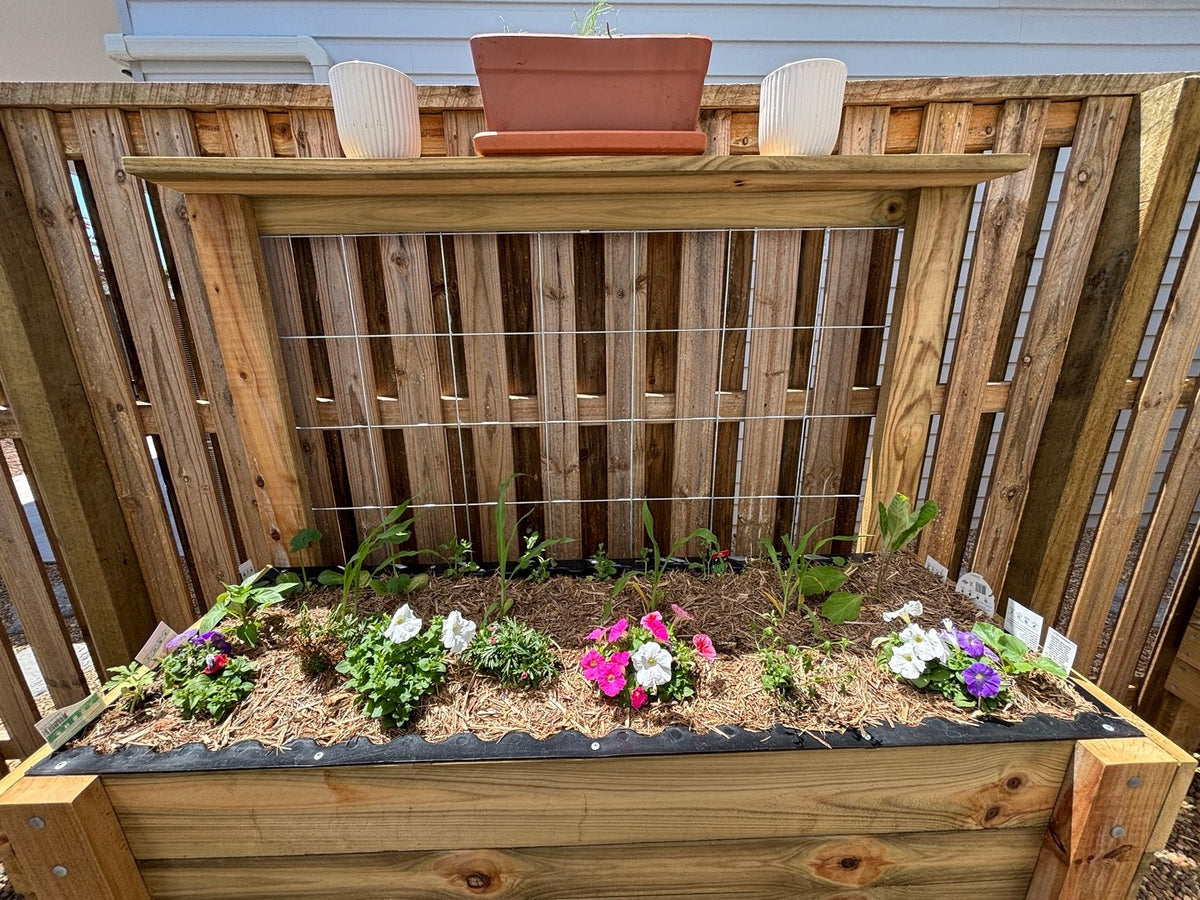
All of this is easier when the bed is made for it. Ours are timber, they stand on legs, and every one of them takes the drainage channel.
- In South East Queensland? We build it, deliver it and set it up in your yard, fully assembled — our best selling raised garden beds in SEQ.
- Anywhere else in Australia? The same beds ship as flat-pack kits with the tools included — raised garden bed kits shipped Australia wide.
- After something lower? Our planter boxes sit at knee height and take the same add-ons.